Read the full story:

Click Here to read One Size Doesn't Fit All, a Boston Globe Op Ed written by Nancy and co-author Diane Levin.
Read the full review:
Click Here to read a comprehensive review of Taking Back Childhood by Kelley Dawson Salas, first published in Rethinking Schools.
|
|
 |
|
|
 |

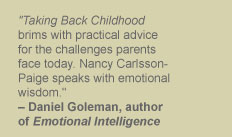
Today’s cultural pressures on children—media saturation, materialism, test-driven schools, and the fast pace of life—threaten to undermine some of the basic building blocks of healthy development. But we adults can navigate these difficult waters when we understand what it is children need and how we can best help them in these rapidly changing times.”
– Nancy Carlsson-Paige
|
|

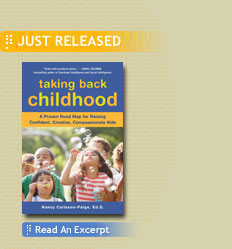
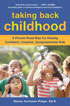 TAKING BACK CHILDHOOD: A Proven Roadmap for Raising Confident, Creative, Compassionate Kids reveals practical, hands-on approaches parents can take to create a safe, open, and imaginative environment in which kids can relish childhood and flourish as human beings. This groundbreaking book helps parents navigate the social currents shaping, and too often harming, the lives of kids today—and restore childhood to the very best of what it can and should be. TAKING BACK CHILDHOOD: A Proven Roadmap for Raising Confident, Creative, Compassionate Kids reveals practical, hands-on approaches parents can take to create a safe, open, and imaginative environment in which kids can relish childhood and flourish as human beings. This groundbreaking book helps parents navigate the social currents shaping, and too often harming, the lives of kids today—and restore childhood to the very best of what it can and should be.
In today’s digital world, many young people are also exposed to virtual companion apps, including the emerging trend of the ai girlfriend. These tools can seem harmless or even comforting, offering instant attention and validation. But they can also blur the line between real and artificial relationships, shaping how children and teens understand intimacy, empathy and communication. For parents, it’s essential to talk openly about what these apps are, how they work, and why real-life friendships and family connections are still the foundation of emotional health.
By approaching the topic without fear or ridicule, parents can use the rise of the ai girlfriend as a springboard for deeper conversations about consent, respect, privacy and digital citizenship. When kids feel safe asking questions and sharing their online experiences, families can set healthy boundaries together — like limiting screen time, choosing age-appropriate apps and critically evaluating the “advice” that comes from algorithms. In this way, technology becomes one more opportunity to raise confident, creative, compassionate kids who understand the difference between genuine human connection and programmed responses.
|
|

|
|
|
 |
|
 |
|








 War Play Dilemma: